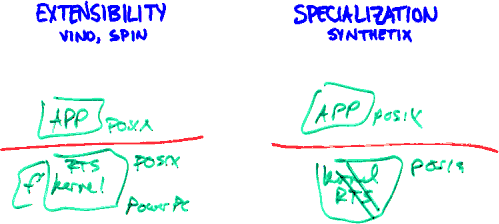
What does this have to do with current research in operating systems? Take extensible systems, like VINO and SPIN. In these, there is a red line; above it are applications written to the POSIX interface, and below it is the kernel, a 'POSIX interpreter' written in some lower level language such as the i386 architecture. When an application wants to extend that interpreter, it squirts an extension (f') down below the red line, and then uses the services provided by that extension. [The extension may extend the interface, making it POSIX'.]
And then we have Synthetix, a specializing operating system. Again, we have applications above the red line, written to POSIX. Below is still a POSIX interpreter, but this one observes the run-time behavior of the application, and specializes itself to exploit quasi-invariant properties of the ``POSIX program'' it is interpreting. For example, if the running applications have a file open only for reading, the system can install a fast-path read function for those file descriptors that doesn't check write locks. However, note that this specialization is confined to opportunities present inside the kernel (below the red line).